Airport robots are being asked to move bags, guide people, clean floors, and inspect busy spaces. The useful changes will come from systems that can work around staff and passengers without creating extra stops.
Quick read
- Baggage robots must fit existing carts, doors, and handoff points
- Passenger robots need clear answers and a safe way to stop
- Cleaning and inspection robots need proof from full shifts, not short demos
Baggage movement needs better handoffs
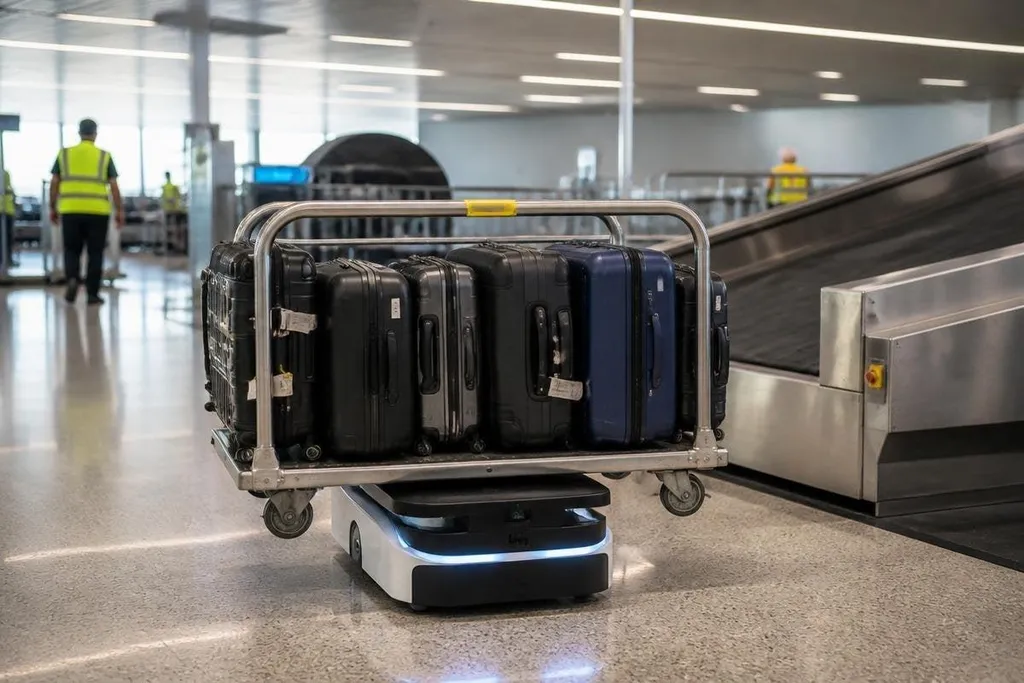
Baggage movement is a practical place for robots because the work repeats across set routes. A mobile robot can carry a cart or container between a loading point and a sorting area, then wait for a person or another system to take over.
That handoff matters more than the robot's top speed. If a door is closed, a cart blocks the route, or a worker needs to cross the path, the robot must slow down, stop, and choose a safe next action. A system that needs a clear floor all day won't fit an airport for long.
Watch for robots that connect with existing baggage equipment instead of requiring a new layout. The useful proof will include route completion, stops caused by people, battery changes, and the number of staff needed to supervise each robot.
Passenger help must work under pressure
A robot with a screen, camera, microphone, and map can answer routine questions or point people toward a gate, service desk, or baggage area.
The hard part is handling a crowded terminal, several languages, poor lighting, and a passenger who asks for help in a different way from the one used in training.
Voice control also needs a backup. A screen with large buttons can help when announcements are loud or a microphone misses a word. The robot should show its answer, give a clear route, and let a person take over when the request falls outside its limits.
For a passenger, the measure is easy to understand: did the robot reduce the time spent searching, or did it send someone to a staff member anyway? Airport operators should publish that result beside the number of questions answered.
Passenger traffic, baggage carts, and staff handoffs give airport robots a harder test than a staged terminal run. Robot 24 can connect named machines with trial sites and reported results before the article turns to cleaning and inspection robots.
Cleaning and inspection robots need long runs
Cleaning robots can follow mapped routes, avoid people, and return to a charging point when their battery runs low. Inspection robots can carry cameras or other sensors through areas that need regular checks, but their value depends on what happens after they collect the data.
A camera image alone doesn't fix a spill, damaged surface, or blocked passage. Staff still need a clear alert, a location, and a way to confirm that the issue was handled. That link between detection and action is where many projects will earn or lose their place in an airport.
The best evidence won't come from a short video. Look for records from full operating periods, including missed areas, false alarms, charging stops, and work done after an alert. Those details show whether the robot reduces work or adds another screen for staff to watch.
What to check before calling it a breakthrough
The word can mean a new sensor, a lower price, or a robot that works in a place where older systems stopped. I'd judge the claim by the work completed without extra staff, blocked routes, or manual resets.
Use this checklist when an airport robot project makes a large claim:
- Name the job. Check whether the robot carries a defined load, answers a defined set of questions, cleans a mapped area, or records a defined inspection.
- Measure a full shift. Ask for route time, battery stops, manual resets, and missed tasks across normal airport traffic.
- Check the handoff. Find out who takes the bag, acts on the alert, or helps the passenger when the robot reaches its limit.
- Count supervision. A fleet that needs one person per robot may not reduce staff work.
- Test the exceptions. Ask how the system handles blocked paths, lost network service, noise, low light, and a person who steps into its route.
These checks also show what is still unproven. A robot may move well in a marked test area and still struggle with a terminal that changes by the hour.
The next airport robot worth watching will have a simple record: the task, the hours worked, the stops, and the staff time it saved. Until those numbers are public, treat the demo as a promise, not a result.